I secured the location for our film opening! We plan to film at the Super 8 Motel, which seems suitable for everything that we wish to film! It’s located all the way in Tampa, which is slightly inconvenient, but since it should only be for one day, I don’t think that it will pose too much of a problem.
In order to shoot at this motel, we had to book a room to shoot in. After perusing their possibilities, I landed on the 1 King Bed, Efficiency, Non-Smoking room that they had available. It not only seemed like the biggest room they had, but it also had a lot of amenities that made it seem closer to an apartment room than a motel room.
I’ll go into detail in a later post about why I found this to be a vital aspect.
I was tasked with book the room and securing the location, which is a very new concept to me. I’ve never booked a hotel/motel room before, for fairly obvious reasons (hint, hint – you can’t book a room without a credit card. Besides, I’ve had no reason to).
My dad offered to let me use his credit card to pay for the hotel room although, of course, we’ll have to pay him back later.
The process was rather painless, but also mildly terrifying. I had no idea what they were going to ask for or what I needed to say to the person on the other side of the phone. Luckily, the nice receptionist on the opposite end of the line did most of the talking and lead the conversation with most of the questions – like ‘which room would you look to book?’ and ‘when do you plan to check out?” – so I didn’t have to act too much on intuition.
It was essentially like taking a class and learning all of the information, but not studying for an upcoming test, but luckily it’s a verbal test were the teacher gives hints to jog your memory of how to respond. Mildly terrifying, but not quite completely terrifying.
As I go along this project, I realize that I’m learning a lot of new stuff, both film and non-film related things that will most likly benefit me in the future.
In the end, the price of the room for literally one night was $120. ONE NIGHT! In a motel!
A video of me wasting my money on this motel
However, it is split between four people and my dad has agreed to take on $20 dollars of the total expense.
BUT he also said that he’d work it off of me with extra chores down the road. So moral of the story is, my groups members owe me.
This is the official script I created for our title sequence! We’re one step closer to actually filming something! It is worth noting that things are subject to change and onset changes or difficulties with certain shots might divert the way we go with the opening. However, this is the projected idea and what we plan to cohere to.
If the text in this post is too hard to read, a link to a Google Document housing the same text will be provided at the end. Enjoy!
Screenplay
FADE IN:
EXT. MOTEL – EVENING
A two-story, brick motel stands against an urban landscape, the setting sun gleaming from behind the building
INT. MOTEL ROOM 1 – EVENING
We see the windows, the faint light of the fading sun peeking in. It is almost night. The television is on, the sound of a static-filled news report droning on in the background.
CUT TO:
Corners of the plain, beige room. The air conditioner, magazines spread across a table. The droning of the news station grows quieter. In its place, the sound of a water droplet falling against a body of water emerges.
A push in towards the face of a young adult who is sleeping in a bed in the middle of the bedroom. He is LIONEL. The dripping grows to a crescendo, stopping abruptly with an echo as we see Lionel open his eyes. He gazes around the room for a brief moment before sitting up in bed. He is dressed in his pajamas.
Lionel reaches over to the nightstand to his right, grasping for the remote. Instead, he grabs a bright red cloth. Slightly confused, he glimpses downward at the cloth before shifting it to his other hand, reaching again for the remote. He glances at the remote briefly, searching for the power button, before shutting the television off. The room is silent, except for a faint dripping.
Lionel swings his feet off of the bed, placing his bare feet onto the deep blue carpet. A mid shot of Lionel. We see a blurry image of a figure dressed in a red gown appear behind him on the opposite side of the bed, their face and figure obscured by his. He swivels his head quickly, only to see nothing there.
Unmoved, Lionel stands up and walks forward, his attention recaptured by the dripping.
INT. MOTEL ROOM 2 – NIGHT
Lionel opens the door to his room, following the sound. He finds himself in a separate room, as plain and beige as the first. This room is filled with furniture: a table, a couch, a sink. This sink is not dripping.
Lionel walks further into the room, still clutching the cloth.
INT. MOTEL BATHROOM – CONTINUOUS
A wide shot. We see Lionel walk and stop in the frame of the bathroom door. In the foreground, a faucet that is out of focus. Lionel turns his head towards the faucet. The focus shifts. The dripping faucet is now in focus. Lionel walks into bathroom, looming over the bathroom sink. We are looking up at him. He twists the handle, stopping the drip.
CUT TO:
We are now above Lionel, looking into the sink with him. The sink is full of water. A phone is submerged in it. Lionel looks harder, slightly confused. The phone begins to ring, garbled and distorted beneath the water. Only slightly surprised, Lionel lifts the phone out of the water and shakes it slightly.
He looks to his left, towards the innards of the bathroom. All seems normal. The towels and rags are neatly placed. The bathtub is empty.
Lionel picks up the phone. A young man’s voice says over the line:
VOICE
(over phone)
Do you remember… anything?
The voice pauses at odd intervals and is dull and hushed. His voice is distorted and full of static. Lionel stares blankly. He does not reply.
There is an uncomfortable pause. Silence, except for the unsecure phone line, which is crackling slightly.
VOICE
(over phone)
It is of utmost importance… that you remember… what happened.
There is a slight pause.
VOICE
(over phone)
Do not fear. I will help you… remember. I will heal you.
The dripping sound begins once again. We see Lionel from the right. He turns to the left, looking into the bathroom once again. A faucet is dripping slowly into the bathtub. It is full of water.
The voice continues.
VOICE
(over phone)
Step in.
The call ends abruptly. The disconnect tone sounds loudly in Lionel’s ear. He releases the phone, the handset dropping rapidly to the floor.
CUT TO:
We see the phone hanging in the foreground, dripping water. Lionel is walking towards the bathtub. He is mesmerized by the water.
Lionel walks slowly into the bathroom, the disconnect tone fading. His feet stop just before the tub and he peers down into the tub of water. He slowly lifts his right foot and steps in.
CUT TO:
We see Lionel from outside the door of the bathroom as he puts his feet into the bathtub and sits down in the water. Some water spills out of the side of the tub and splashes onto the floor.
Lionel slowly lowers himself into the water, short, small, bodiless whispers rising in volume in the background. These seem to encourage his actions, all merging together into an overwhelming mass of sound. He is still clutching the red cloth.
He finally lowers his head into the water, continuing to hold the red cloth as he submerges himself completely. The whispers grow to a crescendo, now sounding more like soft yelling. A close-up of his hand holding the cloth is seen, being the last part of his body to enter the tub.
After actually experiencing writing the script, I can say, without a doubt, that it is largely different from writing a playscript. Writing a screenplay was closer to writing a book or a short story than a theater script, which is fine by me.
For the most part, it was a very pleasant experience. I enjoy imaginative writing in general, so this was basically another short story project.
Doubling as the director and scriptwriter was a great move
for our film in general. The director’s main job is to control a film’s artistic and dramatic aspects and visualize the
screenplay (or script) while guiding the technical crew and actors in the fulfillment
of that vision. What better way to direct a film’s aspects and visualize the
screenplay than to make the screenplay themselves? This not only reduced any
confusion or complicated discussion about what the film opening should look
like, but it also allowed me to provide a full visual image of how the sequence
might play out
This is evident in Get Out (you know, the one I’ve referenced about 20 times already), where the director, Jordan Peele, also wrote the screenplay for the film (which he wrote in less than two months!).
I like Get Out. Can you tell?
This was necessary as the idea for Get Out was Peele’s, meaning he needed to write it himself. Had he gone to another person to write the script, certain elements that he had imagined might not have come out the way he wanted. He needed to layout his vision completely for the crew and actors to see when they read the script.
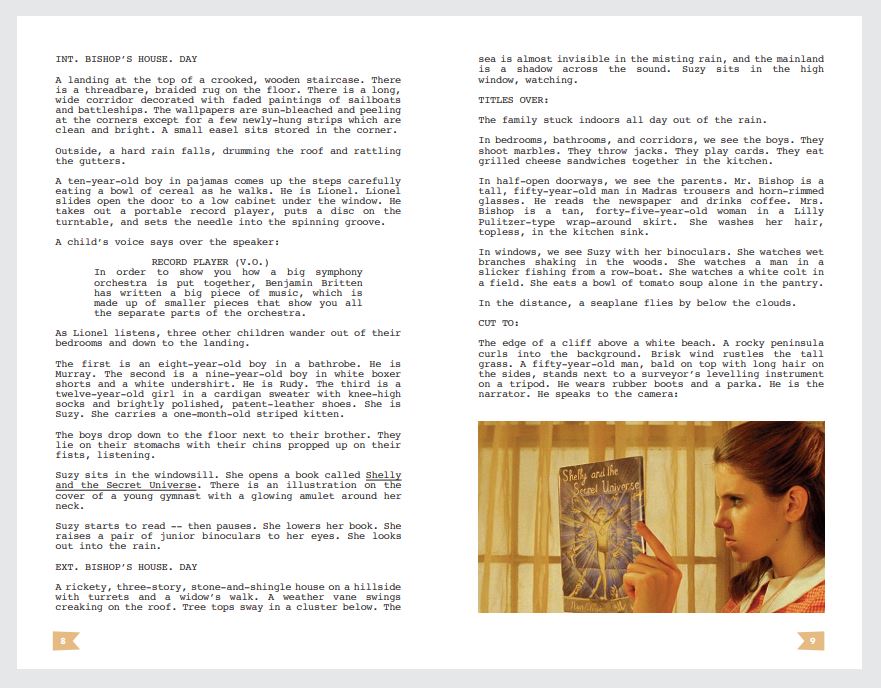
To write my group’s script I took inspiration from Moonrise Kindgom by Quentin Tarantino and, surprise surprise, Get Out (beware, the script for Get Out contains multiple swear words.)
The script for Moonrise Kingdom was especially helpful because
of the lack of dialogue in the first few minutes of the film. As my group’s
title sequence is also planned to have very little dialogue included in it, I
felt that looking at screenplay that also followed this trend would be beneficial
to look at. In doing so, I found that, in lieu of dialogue, a screenplay will
input descriptions and details about the setting and character actions to help readers
view what is planned to appear onscreen. I used this method in our script.
However, our script did have a small amount of dialogue
planned. The screenplay for Moonrise Kingdom did have dialogue in later pages
of the script, but I also wanted a second example by which to format our own.
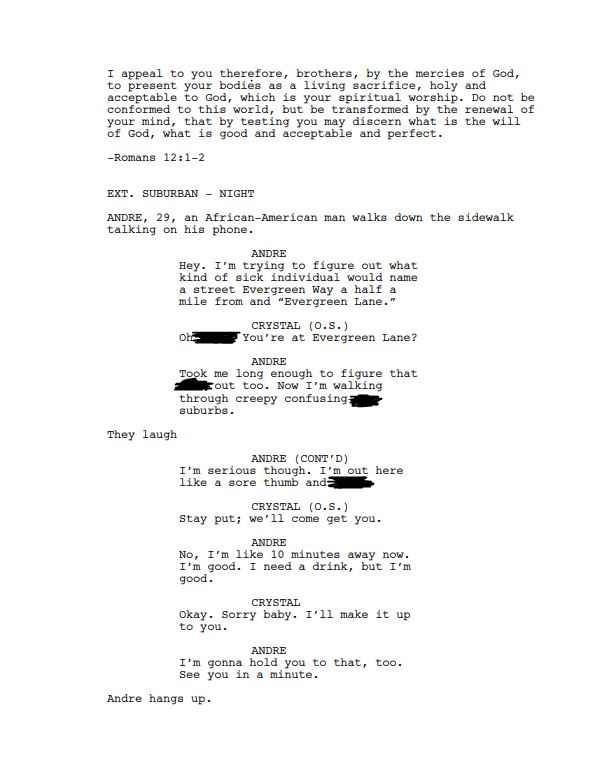
Since I knew Get Out had back and forth dialogue over a phone in its opening,
which I planned to implement in our screenplay, I felt it would be helpful to
look at the beginning of that script as well.
The format of the dialogue was helpful to look at, as I was
able to learn that small sentences in between the dialogue is useful in helping
further the audiences’ understanding of the actions of the characters onscreen
as the dialogue is occurring. This was also seen in Moonrise Kingdom’s script. I
also utilized this in our screenplay.
I had to censor this page. Be careful – this screenplay contains multiple swear words!
The last thing I was able to notice in both screenplays was that
the vocabulary, sentence structure and such rhetorical devices used within the
writing was also important. Rhetorical devices are techniques that an author or
speaker uses to convey meaning to the listener or reader, such as to persuade them.
In order to better portray the tone of the film through the words of the
screenplay to the readers, it is best to utilize these. (My English teacher
would be proud).
This is most evident in the script for Moonrise Kingdom,
whose screenplay reads more like a book that a script. This can be seen when
the scriptwriter uses sentences like “the sea is almost invisible in the
misting rain, and the mainland is a shadow across the sound.” Not only does the
sentence use a metaphor, but the vocabulary used (misting, shadow) imparts a gloomy
tone and a sense of mystery onto the writing. I tried my best to add this to our
screenplay.
Overall, the process for creating the script was greatly
enjoyable. It allowed me to be creative and spend some time visualizing the opening
and how our group might go about filming it. I will post the finished script in
a later post.
This isn’t the first time I’ve tangoed with scripts. I’ve not only written some in my free time and for extracurricular projects, but I also took a theater class two years ago. I read and analyzed a few scripts in the class, wrote some of my own and even participated in a play, named “Is He Dead?”, allowing me to get up close and personal with the format of theater scripts. However, I’ve come to realize that, despite their similarities, film scripts and theater scripts have glaring differences.
The script I was given for the play “Is He Dead?” Excuse the large, faded writing
A screenplay – or the script and often shooting directions of a story prepared for a motion picture – and a playscript – or the manuscript of a play, especially as prepared for use by actors in rehearsals – do have their similarities (Merriam-Webster) (Dictionary.com). They both present the dialogue of the characters as well as briefly outline the actions characters may take between dialogue. However, this brief list is about where the similarities end.
Essentially, a screenplay’s primary tool is structure while a playscript’s primary tool is dialogue. While playwrights do need to visualize to some degree what is happening on the stage in order to create the dialogue, this doesn’t necessarily need to be communicated to anybody else. The director can be relied on for this image and things can be altered since plays have rehearsals. Films, on the other hand, do not often have rehearsals for the actors, so the actors and crew need to be able to see the film and the big elements in their mind when reading the screenplay. For a screenplay, you need a much more substantial infrastructure (WriteYourScreenplay).
As a result, the professional format and elements of screenplays and playwrights are also vastly different. There are more differences in certain features of playwrights and screenplays, such as a cast of characters and stage directions – the stage actions, movements of performers or production requirements that are written into the script of a play (Dictionary.com). However, I will mainly be talking about the fundamental differences between the two.
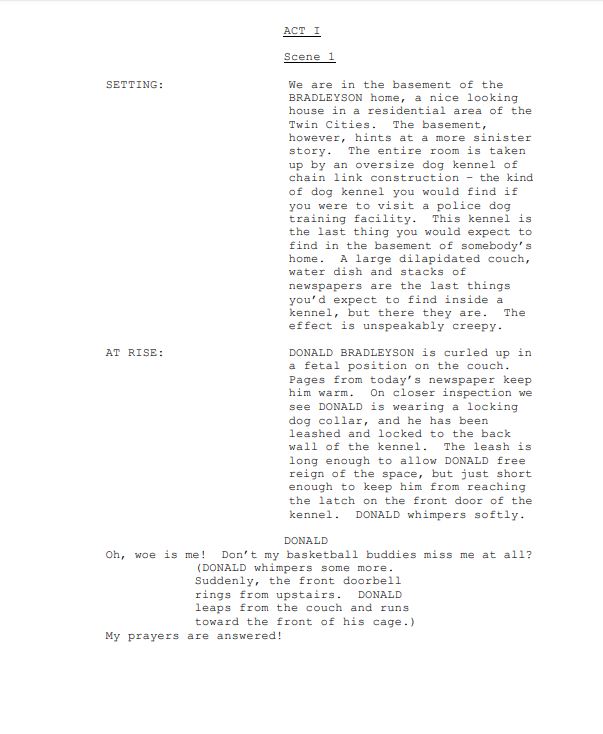
Playscripts often begin their scripts with a very detailed description of the setting that the first scene is taking place in. This is so the actors and production crew can get an idea of the setting that the action will take place in as the scene will rarely stop to describe it again. The scenes of plays often remain the same for the whole scene or longer, meaning that the settings do not need to be described as frequently as in screenplays.
An example of the first page of a playscript
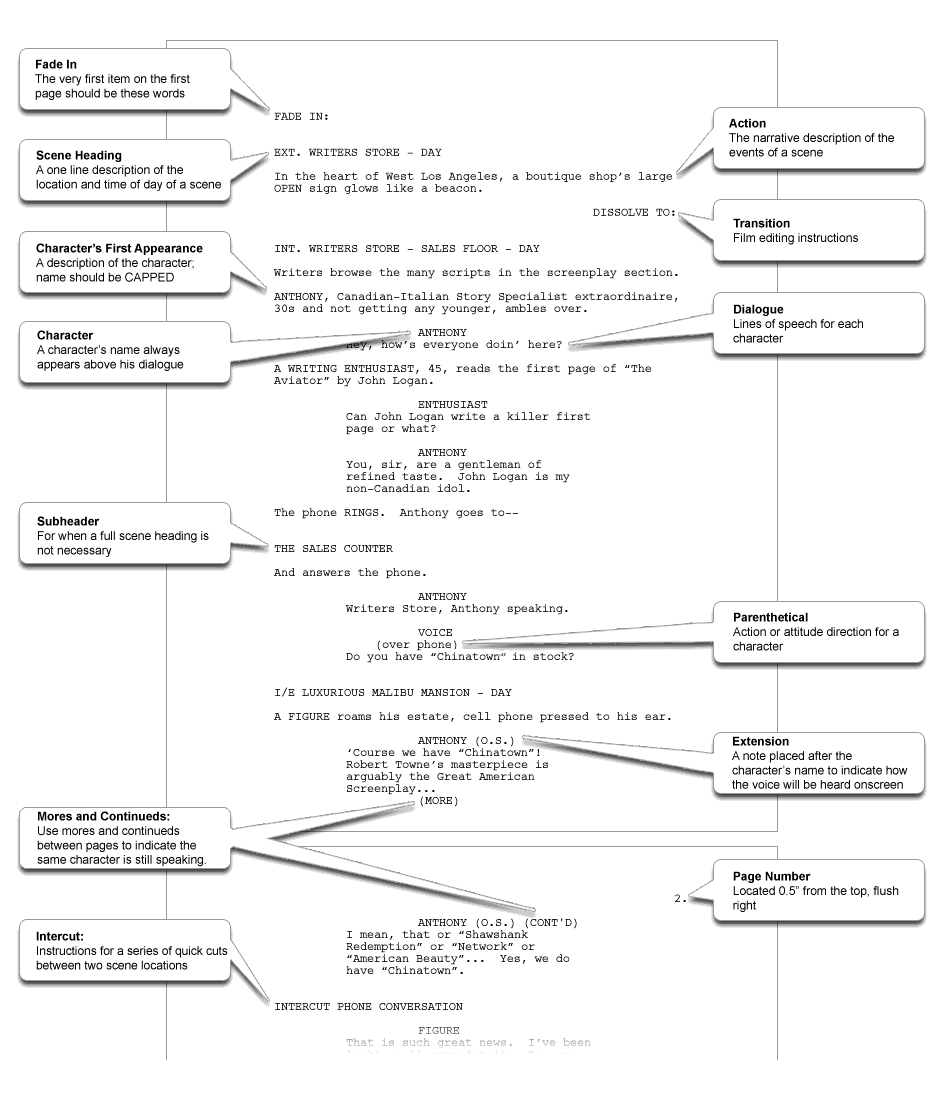
Another difference lies in the vocabulary of the scripts. As I have been learning in my Media Studies class, film has entirely different terminology than that of theater. This can be seen at the beginning of new scenes or settings in screenplays. The transition that the film undergoes, such as a “fade in,” which is an optical effect where a shot appears gradually out of darkness, is displayed where appropriate (CollinsDictionary). If there is no transition between scenes, a new scene heading is written. A scene heading is a one-line description of the location and time of day of a scene. An example of a this is “EXT. WRITERS STORE – DAY.” “EXT” stands for “external,” indicating a shot outside of the designated location, which, in this case, would be a writer’s store. This shot is also indicated to take place during the day. These scene headings are essential for the actors and crew to understand the context of the scene, due to their tendency to change rapidly.
In the case of characters, when they are introduced, a brief
description of them is provided, similar to a cast of characters in a play, except
they only occur at each characters’ introduction instead of at the beginning of
the script. The characters’ following dialogue is placed in the center of the
page and a parenthetical, or action or attitude direction for a character, can
also be present, specifying the context of their dialogue. For example, before
a line of dialogue, a parenthetical stating ‘(over phone)’ can specify that the
ensuing dialogue is taking place over a phone call.
The last main difference and specific element of screenplays
is the extension next to the name of a character before a line of dialogue. This
extension is a note placed after the character’s name to indicate how the voice
will be heard onscreen. For instance, the extension may read ‘(O.S.)’ to
signify that the character will be speaking onscreen, or perhaps ‘(V.O.)’ to indicate
that the character’s voice is in fact a voiceover.
Overall, these differences and specific features of a screenplay
will better help me compose the screenplay for my group’s title sequence. As I
have been tasked with this element of the project, I hoped to get a full
understanding of how to create the script to allow for the best understanding of
the planned shots for the title sequence as possible.
The exhibition of our film will be one of the biggest parts of a film’s process. Following the production and distribution phase, exhibition involves the public screening of a film, usually for paying customers in a site devoted to such screenings, such as a movie theater. The exhibitors have, to some extent, control over how films are programmed, promoted and presented to the public, so they have considerable influence over the box-office success and perhaps, the reception of the film (Film Reference).
The definite exhibition method that we are aiming for with our movie is exhibition through film festivals, such as the Sundance Film Festival or Raindance Film Festival. There are many benefits to attending these festivals. The first and largest reason is that hype and anticipation for the film’s release is greatly heightened from its attendance at one of these festivals. Critics are able to look at a film and rate it before its wide release and word of mouth about a film’s quality also has the possibility to spread and hype up the film. Movies such as “The Farwell” and “The Last Black Man in San Francisco” have generated a great amount of anticipation at the 2019 Sundance Film Festival for their distribution by A24 Studios and eventual exhibition (HighsNobiety).
Another benefit to attending film festivals is the
opportunity to win awards. These awards would not only serve as a symbol of the
hard work that went into the production of the film, but it would most likely
also draw in more viewers as the award would serve as a validation of the movie’s
quality. If our film was stamped with an award from a film festival before being
exhibited to the public, audiences would most likely assume that the film is of
high quality, allowing it to compete with other films that already have established
directors or actors.
Lastly, for these film festivals, networking is another
large benefit for attending. Making lasting connections with those in the film
industry is said to be one of the most important things if one wants to be
successful. Therefore, putting oneself out there to meet new people behind the
scenes and with connections in the film industry by attending and showing one’s
film at a film festival, is a move that will certainly benefit them in the
future.
In terms of theatrical exhibition, we hope to have a wide
release and show our film all across America. With a well-known production
company such as Blumhouse, I believe out film will have a much higher rate of
success. Additionally, if Universal Studios, who has a 10-year first look deal
with Blumhouse, chooses to distribute our film, distributes our film, our film
will most likely be marketed and received even more positively. As Universal
Studios is a powerful force in the distributing world and has great expertise, their
choice of an exhibitor and marketing strategies, will most likely be of grater
quality.
However, in the case of Universal Studios rejecting our
film, our group has chosen A24 as the second choice for a distributor thanks to
their experience with distributing low budget horror films, such as “The Witch.”
A24 can route our movies through the theater with a theatrical exhibition but
can also guide our film through non-theatrical exhibition as well. They have a
contract with Amazon Prime Video and also release some of their movies on
DirecTV Cinema. I’m confident that A24 would be able to guide us through other
ways of allowing audiences to have a home viewing of our film. Of course, this
would also be possible with Universal Studios, who have great connections as
well.
Personally, I believe the branding for our film was a one of the most difficult elements for our project to come up with. There are so many things to consider when deciding what will be the main feel and imagery used in the film, especially the plot, which was a whole other monster. More on that in a later post.
Despite this, a plotline was finally produced, and my group could then settle on the look and feel of the film/title sequence that we were going for. Thanks to the film poster that one of my partners, Ben, created in his free time, we were able to pinpoint a certain tone and some imagery that we’d like to include or allude to.
The film poster that one of my group partners, Ben, created
It is worth stating that this is still a draft of a film poster
and has not been set in stone yet. However, it still portrays some essential
pieces that we intend to include in our brand.
The mysticism and striking image of eyes is a theme and
common visual that we would use throughout the film (if it was a feature length
film) and have associated with our movie. Although eyes are a common visual
used within the thriller and horror genre, I believe that including the unusual
and distinct pastel colors would help the film stand out from the rest.
Speaking of colors, a more monotone or gray palette is
planned to be used along with the bright pastel colors to provide a stark
contrast. However, this might be difficult to achieve as there are few settings
that are naturally monotone and editing settings to be more grayscale in post-production
might impart an unintended artificial look onto the title sequence. At the very
least, we plan to add a stark contrast between a monotone or bluish setting and
brightly colored props.
Additionally, the theme of rippling water, static and blurry
images are planned to be a part of the brand of our film. To help add to theme
of mystery and lack of clarity in the thriller, this symbolism is intended to
be utilized in the title sequence and branded with the film.
OUR GOAL
The goal of our film is to not only keep audiences on the
edges of their seats with riveting imagery and mystery that keeps audiences guessing,
but also to immerse them the world of the film, guiding them along each twist
and turn with a carefully crafted story.
Our film, Lucid Elucidations,
is a mystery/psychological thriller film that focuses on one man whose
past is unclear and his surroundings even more so. He doesn’t remember who he is, let
alone what he did. He
can’t remember, but he needs to – at least, that’s what the voices keep
telling him. He’s a prisoner of his own mind and the fantasies and illusions it weaves,
caused by head trauma, injuries that landed him not only in the hospital, but
also a mental
facility. In a world where the line between fantasy and reality is indistinguishable,
this film explores this man traversing through his memories to figure out the
truth. Not only what he supposedly did, but also what his mind is trying to
show him.
Our Production Company
We’ve chosen Blumhouse Studios
as our production
company given its specialty and experience
producing quality horror films on a generally
low budget. Blumhouse has
produced many successful
horror films such as Get Out (2016), The Visit (2015) and Happy Death Day (2017). All of these
films are similar to ours thematically
in the sense that they appeal to the viewers’
sense of uneasiness and contain psychological
elements that perturb the audience.
Budget
For our film “Lucid Elucidations”,
we will have a low budget of approximately $5,000,000. We decided
on this number after researching similar thriller films produced under Blumhouse Productions,
such as Get Out and The Visit,
whose budgets were approximately $5,000,000
each, and Truth or Dare, whose budget was $3,500,000. Within this budget,
we will not be
spending it towards buying the rights for the script as we will be writing our own.
However, we will have to split our budget amongst other factors, such as
salaries for the
cast and crew, camera equipment, costuming, makeup, props, set construction,
and any
possible travel fees such as hotel rentals, gas, etc., to name a few.
Distribution
After extensive research into
which distribution company would be best for our film, ‘lucid elucidations’, we have a few possible
options for what we will choose. We firstly
will premiere our film at Sundance film festival, where there is a chance for
the movie to build a reputation and credentials, such as awards or praise from
critics. Our chosen production company, Blumhouse productions,
has a 10 year
“first look” deal with universal pictures, allowing universal to get
the first
glance at any new work from Blumhouse productions
and decide rather or not they
will approve of the film or not.
In the case Universal Pictures does not approve of our film,
we choose A24 films as our selected
distribution company, as they have produced films that fit into a similar genre
as our film, such
as “The Witch” (2015) and “Hereditary” (2018), which also have similar budgets
to our film, as “The
Witch” had a budget of $4 million USD and “Hereditary” had a budget of $9
million USD. Due to the fact that they have made lower budget films similar to our
genre, which were very
successful (“Hereditary” grossed $44 million USD with a $9M budget), we feel as
if they would be
our next best choice of distribution company.
My group and I have not only been unsure as to what the
brand of our film should be, but what the brand of a film is in general.
Although a product’s brand, such as Pepsi, comes to mind, I have a feeling that
a film’s branding is slightly different. As such, I decided to take a quick
look into the ins and outs branding a film in order to be able to brand my film
properly for my film pitch.
Apparently, just like product branding, a film’s branding
stands to help attract attention to the film, especially in the midst of so
many other films being in the market at the same time. Branding can even be
seen as an important part of the culture that acts as a shortcut to a large
understanding of a person, product, service and so on.
How Can a Film Be Branded?
The first way that a film can connect with brands is the talent being used in the film. For example, is Liam Neeson was in a film, the dynamic and dramatic role that he would likely be taking in the film would be a large selling point. Similar methods to this are connecting films to other popular items that can relate to film: popular books (Harry Potter), famous directors (Quentin Tarantino), popular games (Warcraft), famous studios (Pixar) or popular characters (Frankenstein) (Indie Film Academy).
However, this type of branding is more aimed towards using established
brands. Since our films/title sequences cannot use this type of branding, we
should focus on the other kind – creating new brands with our film. To do so,
our film will need to focus on a specific, popular genre, or in our case, thriller.
The genre is important to be able to connect the film to a larger idea. The message
and elements of the film will need to be consistent throughout. This includes:
A Well-Designed Title
The Film’s Color Scheme
Poster Art
To give a film a proper brand, must have a proper design, a
proper look. If multiple advertisements come out about the move, each must have
the same color scheme and tone.
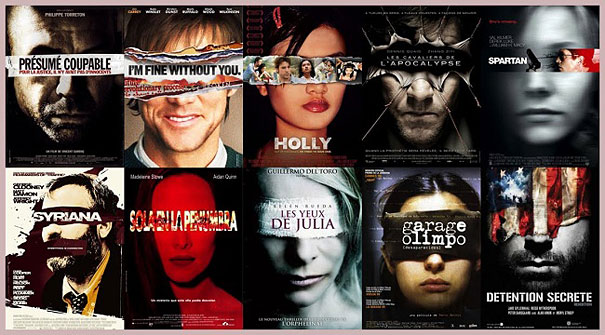
An example of film posters will very similar tones and looks
However, there’s another angle to branding, especially with
horror/thriller films. Originality. If a poster or look of a film is too similar
to that of other films, then the brand of the film will lose its effect and
begin to blend together with all of the other branding. Taking a different
approach to a poster, making it stand out against all of the other posters that
only have creepy eyes and creatures staring back at you, will aid in branding
the film and helping the viewers to remember the film after they’ve stopped
looking at the poster.
An example of generic film posters
Now that I am aware of how to create a brand in film, my
group and I can be more mindful of the look of our title sequence and how it
revolves around a brand.
From first glance, my group thought that A24 films might have been the proper choice, however, we ultimately settled on Blumhouse Productions as our production company. While A24 does produce some films within the horror and thriller genre, the films that it produced vary widely, carrying comedy, sci-fi and dystopian dramas under its belt. While this does add variety and experience as an appeal to their company, Blumhouse seemed to be the better fit because of its focus on producing low-budget horror films specifically. Of course, a deeper look into the production company further convinced my group.
Blumhouse Overview:
Blumhouse Productions is an American film and television production company, founded by Jason Blum, whose surprising main goal is to produce high quality micro-budget films. This low-budget model began in 2009 with Paranormal Activity, which was made with a mere $15,000 and grossed over $193 million worldwide. This is an alluring feature of the production company, having successfully grossed millions from movies that have budgets that aren’t even in the millions. Actually, in the list provided by BoxOfficeMojo, only 2 movies out of the 42 listed grossed less than $1 million dollars worldwide, and only 7 out of the 42 grossed less than $10 million worldwide.
Despite aiming for low-budget production, Blumhouse has produced movies that are now household names, such as The Purge and Get Out.
Get Out film poster
The Purge film poster
What Won Me Over:
Overall, Blumhouse Productions can be considered as the best
production company for our group to pitch to mainly because of its
specialization in low-budget horror films. This not only ensures more expertise
in the execution of horror films, but because they are accustomed to the
schedules and planning of low-budget films, the filmmaking process will likely
be much more fluid and well managed. If this film was aimed at a bigger production
company that specializes in studio films with large budgets, the process may
not be at seamless.
Additionally, as of 2014, Blumhouse has a 10-year first-look deal with Universal Pictures. This allows Universal Pictures to have a first look at any new material that Blumhouse Productions produces as to allow them the first opportunity to purchase and distribute it. This would be a good opportunity for my group’s film, as Universal Pictures, the oldest American film studio, would get to see our production and hopefully distribute it.
Blumhouse has also expanded its multi-platform offerings,
including BH Tilt, a releasing label that takes advantage of new marketing
strategies; Blumhouse Books, a publishing imprint; Blumhouse.com, the
production company’s official website; as well as their own independent
television studio. These marketing possibilities can help my group’s film be
well marketed before hitting theaters.













 Lucid Elucidation's Explanations