
This isn’t the first time I’ve tangoed with scripts. I’ve not only written some in my free time and for extracurricular projects, but I also took a theater class two years ago. I read and analyzed a few scripts in the class, wrote some of my own and even participated in a play, named “Is He Dead?”, allowing me to get up close and personal with the format of theater scripts. However, I’ve come to realize that, despite their similarities, film scripts and theater scripts have glaring differences.

A screenplay – or the script and often shooting directions of a story prepared for a motion picture – and a playscript – or the manuscript of a play, especially as prepared for use by actors in rehearsals – do have their similarities (Merriam-Webster) (Dictionary.com). They both present the dialogue of the characters as well as briefly outline the actions characters may take between dialogue. However, this brief list is about where the similarities end.
Essentially, a screenplay’s primary tool is structure while a playscript’s primary tool is dialogue. While playwrights do need to visualize to some degree what is happening on the stage in order to create the dialogue, this doesn’t necessarily need to be communicated to anybody else. The director can be relied on for this image and things can be altered since plays have rehearsals. Films, on the other hand, do not often have rehearsals for the actors, so the actors and crew need to be able to see the film and the big elements in their mind when reading the screenplay. For a screenplay, you need a much more substantial infrastructure (WriteYourScreenplay).

As a result, the professional format and elements of screenplays and playwrights are also vastly different. There are more differences in certain features of playwrights and screenplays, such as a cast of characters and stage directions – the stage actions, movements of performers or production requirements that are written into the script of a play (Dictionary.com). However, I will mainly be talking about the fundamental differences between the two.
Playscripts often begin their scripts with a very detailed description of the setting that the first scene is taking place in. This is so the actors and production crew can get an idea of the setting that the action will take place in as the scene will rarely stop to describe it again. The scenes of plays often remain the same for the whole scene or longer, meaning that the settings do not need to be described as frequently as in screenplays.
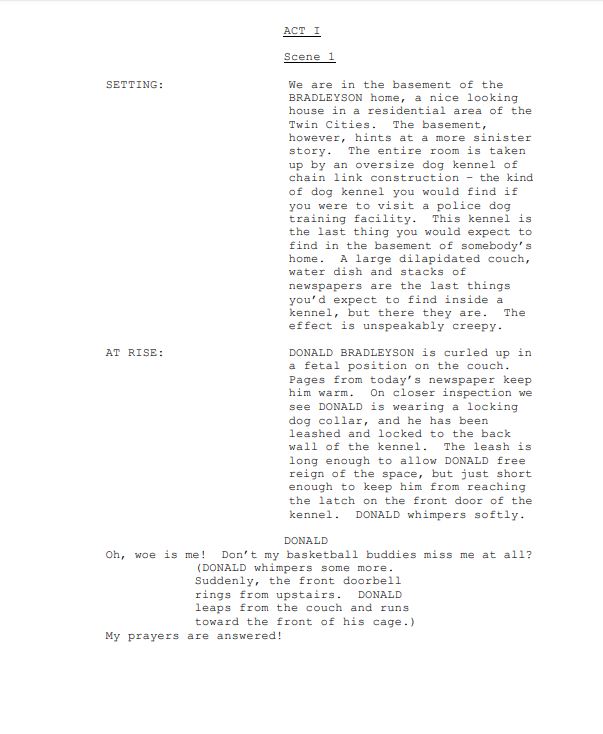
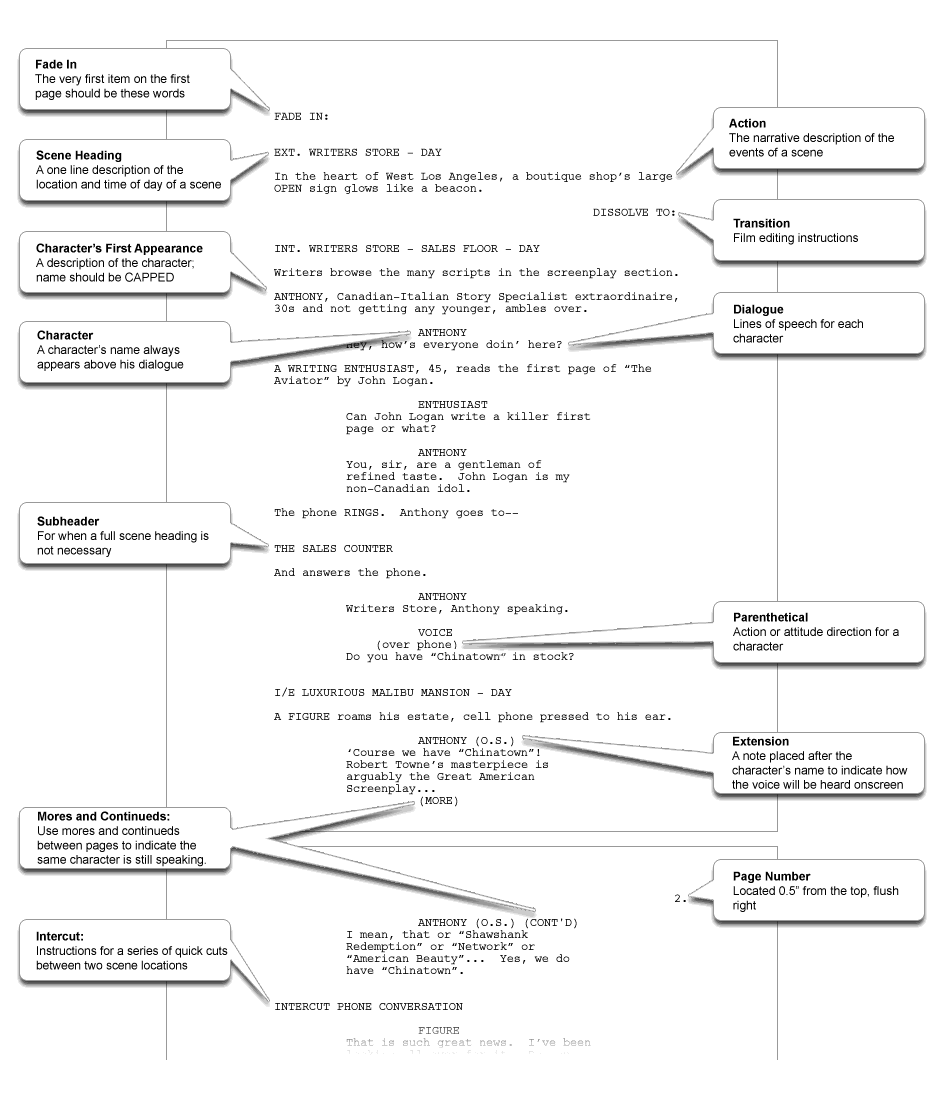
Another difference lies in the vocabulary of the scripts. As I have been learning in my Media Studies class, film has entirely different terminology than that of theater. This can be seen at the beginning of new scenes or settings in screenplays. The transition that the film undergoes, such as a “fade in,” which is an optical effect where a shot appears gradually out of darkness, is displayed where appropriate (CollinsDictionary). If there is no transition between scenes, a new scene heading is written. A scene heading is a one-line description of the location and time of day of a scene. An example of a this is “EXT. WRITERS STORE – DAY.” “EXT” stands for “external,” indicating a shot outside of the designated location, which, in this case, would be a writer’s store. This shot is also indicated to take place during the day. These scene headings are essential for the actors and crew to understand the context of the scene, due to their tendency to change rapidly.
In the case of characters, when they are introduced, a brief description of them is provided, similar to a cast of characters in a play, except they only occur at each characters’ introduction instead of at the beginning of the script. The characters’ following dialogue is placed in the center of the page and a parenthetical, or action or attitude direction for a character, can also be present, specifying the context of their dialogue. For example, before a line of dialogue, a parenthetical stating ‘(over phone)’ can specify that the ensuing dialogue is taking place over a phone call.
The last main difference and specific element of screenplays is the extension next to the name of a character before a line of dialogue. This extension is a note placed after the character’s name to indicate how the voice will be heard onscreen. For instance, the extension may read ‘(O.S.)’ to signify that the character will be speaking onscreen, or perhaps ‘(V.O.)’ to indicate that the character’s voice is in fact a voiceover.
Overall, these differences and specific features of a screenplay will better help me compose the screenplay for my group’s title sequence. As I have been tasked with this element of the project, I hoped to get a full understanding of how to create the script to allow for the best understanding of the planned shots for the title sequence as possible.
Sources:
- https://www.playscripts.com/play/1365
- https://www.merriam-webster.com/dictionary/screenplay
- https://www.dictionary.com/browse/playscript
- https://www.writeyourscreenplay.com/plays-vs-screenplays-podcast/
- https://www.dictionary.com/browse/stage-direction
- https://www.collinsdictionary.com/us/dictionary/english/fade-in
- https://www.writersstore.com/how-to-write-a-screenplay-a-guide-to-scriptwriting/
- https://ptfaculty.gordonstate.edu/lking/CPF_play_formatting2.pdf
 Lucid Elucidation's Explanations