Picking Production

Production companies are necessary in the process of film-making. Involved heavily in the production of a film, these production companies can have a great effect on the quality of a film. These companies are directly responsible for fundraising for the production; they also have the possibility of handling budgeting, scheduling, scripting, production, post-production, distribution and marketing. A company that is prepared will have the equipment and experience to arrange the best product (B2C). Some of the largest advantages of picking a quality production company for one’s film are that:

  1. Equipment is available and enhancements are better
  2. Experience makes a difference with shooting times and all completion goals
  3. The final product is packaged in the best way. Production companies with experience from previous work will help enhance the film’s elements (B2C)

There are too many production companies out there to count. Hundreds of new, independent production companies pop up throughout every year. Monkey Productions – an American production company founded by Jordan Peele, who directed the 2017 horror film Get Out – was formed in 2012, which is fairly recent. Of course, there are the production companies that dominate the market who have been around for decades. Examples of such are Warner Bros. Entertainment, which was founded in 1923, Sony Pictures, which consist of multiple production companies, and Walt Disney Studios. Since these companies are big enough, some also double as distribution companies.

However, there are many production companies that only serve to produce the movie and not distribute them. The ones that do are mainly aimed towards producing and distributing studio films with large budgets, not low-budget films. My group had to look for a production company that only focuses on and specializes in the production of low-budget horror films.

This is how we landed on the decision of pitching our film to Blumhouse Productions to help produce our film.

Sources:

Get Out – A Case Study

Although thriller openings themselves are greatly beneficial for me and my group to analyze as that’s what we’ll be making ourselves, taking an in-depth look into the entirety of a movie’s process will also give my group a good idea as of how to approach our title sequence. After all, looking at a movie’s inner workings may give my group a better idea as of how to go about filming our project.

Get Out (2017) seemed as good a film to study as any, having been regarded as one of the top 10 films of 2017 and nominated for four awards at the 90th Academy Awards. This film was directed, produced and written by Jordan Peele. It was also produced by Blumhouse Productions, QC Entertainment and Monkeypaw Productions.

History/Early Stages:

Jordan Peele

Prior to the development of this film, Jordan Peele had worked primarily on comedy, including the sketch show Key & Peele. He believed that these two genres were actually very connected as “so much of its pacing… [hinges on] reveals.” Peele was actually introduced to producer Sean McKittrick by his comedy partner Keegan-Michael Key, through which Peele pitched his idea and formed the script in only two months.

Get Out’s lead actors, Daniel Kaluuya and Allison Williams were cast in November 2015 – Kaluuya for his strong performances in previous films and Williams for her innocent portrayals in previous roles, which would surprise audiences once she was revealed as an antagonist. These choices were intentional and very well thought out.

Production:

Get Out had a budget of $4.5 million, which is technically not considered a low-budget film at that point but is by no means a studio film. With this, Peel filmed at several locations in Alabama: Fairhope, Alabama; Mobile, Alabama; Barton Academy and the Ashland Place Historic District. The scene containing Rod William’s first appearance, played by Lil Rel Howery, was shot in Los Angeles, a different area entirely from the rest of the movie. Additionally, the shooting time in Alabama was only given a 23 day period to be completed.

The house where the Armitages lived in the movie

Many of Peele’s cinematographic shots and use of props and setting all have great intention and are mainly used to advance the symbolism of the theme of racism and foreshadow the future conflict.

Distribution:

Get Out first premiered at the Sundance Film Festival on January 23, 2017 before being theatrically released in the United States on February 24, 2017 by Universal Pictures. This platforming method of utilizing film festivals with the hope of being picked up by a large distribution company is common of many low budget films. The film grossed $176 million in the United States and Canada and $79.4 million in other territories, adding up to a worldwide gross of $255.5 million. Get Out is the tenth most profitable film of 2017.

Sources:

Peele’s commentary on the movie’s scenes

Local 58 – Community Television

Outside of thriller openings, certain videos that my group and I have been viewing have also been a great source of influence for the upcoming title sequence. A certain Youtube channel, named LOCAL58, uploaded multiple short videos, meant to unnerve and disturb the viewer. Despite not being from thriller films, the techniques used to unsettle viewers might be beneficial to incorporate in our title sequence.

Contingency

This 3-minute video simulates an early American broadcast station named Local 58. In the middle of the broadcast, a “contingency message reel” begins playing, confessing that the US has surrendered to an invading enemy and calls upon the US citizens to “ACT” and, surprisingly, gives instructions as to how to kill yourself, your pets and your children.

The main technique I appreciate about this video is its inversion of expectations. As it is expected for a national broadcast bearing bad news to have the goal of uplifting and encouraging its citizens, the order to place a “loaded firearm… upward to [the] roof of [your] mouth” is certainly not what one would expect and is greatly unsettling.

Another effective technique utilized in this video is the use of sound. The distorted patriotic music is extremely unnerving, as it should be a comforting and recognizable tune for any American. However, this comforting tune has now been inverted into a looping, off-putting sound that leaves viewers uncomfortable. This technique of distorting and inverting normally uplifting tunes could be a technique utilized the opening.

Additionally, the incremental injection of loud static throughout the video allows the discomfort of the viewers to briefly jump into a small state of panic, making the audience even more uncomfortable. This could be another technique used in our title sequence.

You Are on the Fastest Available Route

This video acts much more like a thriller opening, following the point of view of a person driving in a car. Black and white footage of what seems to be a dash cam records the driver’s footage and the GPS can be heard giving directions in the background. At first, the directions are normal, and nothing seems out of sorts, however, as the video continues, the dash cam reveals that the time the driver has been driving is growing by the hours, though they have yet to reach their destination. The roads become more and more rural, overgrown and abandoned and the GPS’s instructions become less and less like an AI’s, instead sounding like a person talking through the GPS.

The subtle changes and implications that the situation is going awry are the most effective parts of this video. The time growing by the hours, the roads growing more rural, the GPS telling the driver to look for signs that say “do not enter” – these all start to slowly unsettle the viewer as they begin to understand that all is not as it seems. This could be a good technique to utilize in my group’s tile sequence.

As the storyline of my group’s opening and plot of the movie overall is not set in stone, it is unknown as to whether we will take a mysteriously disorienting approach, like that of Se7en, or a tense, plot based scene, like that of “The Pact.” Therefore, it is important for me to gather as much inspiration and information to successfully unnerve viewers as to have a range of ideas as to where to direct the title sequence.

The “Se7en”th Post

As promised in a previous post, an in-depth analysis of the title sequence of the movie, Se7en, is in order. The opening sequence for Se7en is quite an interesting one to analyze and is, in my opinion, a staple for the conventions of thrillers and title sequences done right. It is also a vastly different opening from that of “The Pact’ and approaches unnerving the audience and creating tension in a completely different manner.

First and foremost, the title sequence performs is main duty beautifully, leaving the audience with only a bit more information than they entered with, yet giving them enough information to have an idea of what is to come. By utilizing multiple separate shots of hands writing, cutting film and what can be assumed is developing photos in a dark and shadowed setting, the audience is unable to come to a concrete decision on what is occurring, but can assume that some shady and perhaps illegal activity is being conducted in this opening. Also, by only showing the character’s hands and blurry glimpses at their silhouette, the audience is also unsure as to who is completing all the on-screen tasks, working to intrigue and absorb the viewers into the dark world of the film.

This thriller opening also excels at unnerving the audience and setting up the mood and atmosphere to lead the viewers into the main plot and action of their film with a deliberate approach to their mise-en-scene, cinematography, editing, sound, and typography.

Mise-en-Scene

  • Lighting – The lighting of the entire piece is low-key, both to impart a dark and dreary mood onto the opening and to obscure the audience’s vision of the setting and props. This obstruction can also be seen as a way to guide the viewers attention and focus them in on what the director wanted them to see. Overall, the lighting adds to the suspicious atmosphere of the opening.
  • Costuming/Make-Up – Although the audience does not see any of the character’s body except their hands, the filmmakers ensured that this part of their body would also contribute to the feel of the opening. In the few shots we get of the character’s digits, we see fingernails filled with dirt, peeling, filthy skin, and thin cloth wrapped carelessly around their fingers. This helps increases the audience’s discomfort.
  • Props – The props of the opening are the most prevalent: a disheveled book that’s bent out of shape, odd black and white pictures (ex. Picture of the hands with bent joints), a razorblade, a notebook with unintelligible writing, stacks of unorganized papers, a sewing needle – the list goes on. This odd assortment of props that the audience is only allowed a glimpse of adds to the grungy and disheveled feel of the scene and adds to the mystery and intrigue of the viewers.
  • Blocking – The blocking of the opening is one of the most disturbing and revealing parts of the sequence. The unseen character performs some helpful actions, such as dipping pictures into a solution, which can be assumed to be part of the process of developing pictures. This helps to lead the audience to piece together that the character might be performing some investigative activity. However, the character also performs some questionable and disturbing actions, such as cutting skin off his fingers with a razorblade, which confuses and unnerves the audience further, presenting more questions than the title sequence answers.

Cinematography

  • Extreme Close-Up Shots – The entirety of the opening consists of extreme close ups to the different materials and hands of the undisclosed character with the props taking up the majority of the frame in each shot. This simultaneously directs the audience’s attention to the props that are being manipulated to give them clues about what is happening and masks the identity of the manipulator, increasing the overall tension of the title sequence.

Editing

  • Jump Cuts – This cut is a rarely used technique in the film industry – a sudden, often jarring, cut from one shot or scene to another without intervening devices (such as fade-outs) (Merriam-Webster). This means one shot will suddenly cut to a shot of the same subject with nothing in between to serve as a transition. In the opening, an example of this is when the single line the character draws over the child’s eyes in the picture turns into multiple lines that cross out the kid’s whole face with no transition to stitch these two actions together. These kinds of shots serve to disorient the audience and, as it is unnatural for things to happen without explanation, it is slightly disturbing.
  • Fade – The opening utilizes multiple different kinds of fading transitions, such as a fade in, fade out, fade to black, or even no transition at all, with the clip just jumping to the next scene or title card. This variety works to add a bit of chaos to the opening, disorienting the audience and adding to the tension of the scene.
  • Discontinuity Editing – this is an uncommon type of editing, which deliberately uses an arrangement of shots that seem out of place or confusing relative to a traditional narrative (Colgate University). Se7en’s opening is edited in a form that is not chronological and gives little to no sense of chronology that the audience can grasp. This not only further disorients the audience, but it also nods towards the theme of “order vs. disorder” that may come to fruition later in the film.
  • Quick Cuts: In the opening, very few shots last more than 1 or 2 seconds, switching rapidly from one action to the next, sometimes containing small, seemingly meaningless blocking that helps add to the audience’s discomfort (ex. The blood dropping onto the papers. This shot lasts for less than a second). This also helps to disorient audiences and increases the possibility of them paying close attention to the opening as they don’t want to miss the shots flashing past them.
  • Colors – the colors of the title sequence are also not consistent. While usually retaining a dark, sepia coloring, sometimes the entire frame with be engulfed in a deep, blood red color or switch briefly to black and white, which all work to set up a sense of danger and establish the serious theme and nature of the film.

Sound

  • Diegetic Sound – Although this is not a large convention utilized in the opening, certain instances of creaking sounds throughout the opening work to add an extra element to the atmosphere of the title sequence and gives the viewers an idea of the setting of the shady workplace. The audience can now imagine the implied old, creaking floors and run-down state of the current setting.
  • Non-Diegetic Sound – This soundtrack of the opening is an essential part, as the music contains deep, pulsating undertones in the music with whiney, high-pitched noises sometimes occurring that grate on the ears of the viewers. The music is not consistent either, with some sounds sometimes seeming to unnaturally overlap and clash, adding to the discomfort of the opening

Typography

  • As mentioned in a previous post, the typography of this opening is also a very important aspect of the title sequence. When the credits of the actors and crew show up onscreen, very unconventional font that often curves downward and glitches across the screen is used to present their names. This typography is just as discomforting as the rest of the conventions, working to prevent the audience from experiencing any kind of relief from the tension. Had the filmmakers used a calmer kind of font, such as TIMES NEW ROMAN, the audience may have not taken the opening as seriously or have been a bit less tense as the font is not nearly as unnerving as glitching, slanting font.

Overall, despite mainly accomplishing its means of creating tension through mise-en-scene and editing, the filmmakers made sure to have all its conventions working to further its goal of unnerving and disorienting viewers. This approach to a thriller opening is vastly different to that of “The Pact” and has both broadened my perspective on thriller openings and given me more ideas on how to approach my own title sequence. I will make sure to focus all the new aspects I have learned to my group’s title sequence and instill the desired mood in the viewers.

Sources:

“The Pact” – Title Sequence Analysis

An analysis of a thriller title sequence will be beneficial to get an idea of filmmakers’ approaches towards thriller openings. The opening sequence being analyzed is from a movie called, “The Pact.” This opening effectively accomplishes the goal of creating tension and unnerving the audience. Analyzing this approach will help to better understand how to approach my group’s thriller opening.

Also, it is worth noting that this opening does not utilize titles to credit the crew, meaning I’m not able to analyze it for typography. This opening is also around 6 minutes long, which is well outside of the range we have to work with, however I believe that it will still be helpful to analyze this opening and how it utilizes interesting techniques to create tension in the beginning of its movie without revealing too much information.

Mise-en-Scene

  • Setting – The setting of the opening, which takes place in the house, is very mundane and bland, with some walls containing flowery patterns on the old-fashioned wallpaper. This makes sense after you learn that the protagonist is staying at their now deceased mother’s home. This setting can also be seen as a way to begin the audience comfortably, in a neutral environment, with no reason to be nervous or tense.
  • Lighting – The scene begins with high-key lighting, starting in the morning, but becomes increasingly, and almost unnoticeably darker, and low-key lighting is utilized as night falls and the situation becomes creepier and more mysterious.
  • Props – the props utilized throughout the house – the pictures, lamps, chair, drawer, etc. – all work to immerse the viewers into the setting of the house and the world of the protagonist. A blinking light is also used in one shot to foreshadow some strange happenings that are about to occur.
  • Blocking – throughout the opening, the protagonist’s moves are often very slow and casual. In the beginning, this adds to the calm feel of the beginning of the scene. As the opening slowly descends into creepier territory, her movements become even slower, like when she slowly walks to the pitch-black door after the conversation with her daughter. This contributes to the slow and drawn out feel of the scene, which increases the tension.

Cinematography

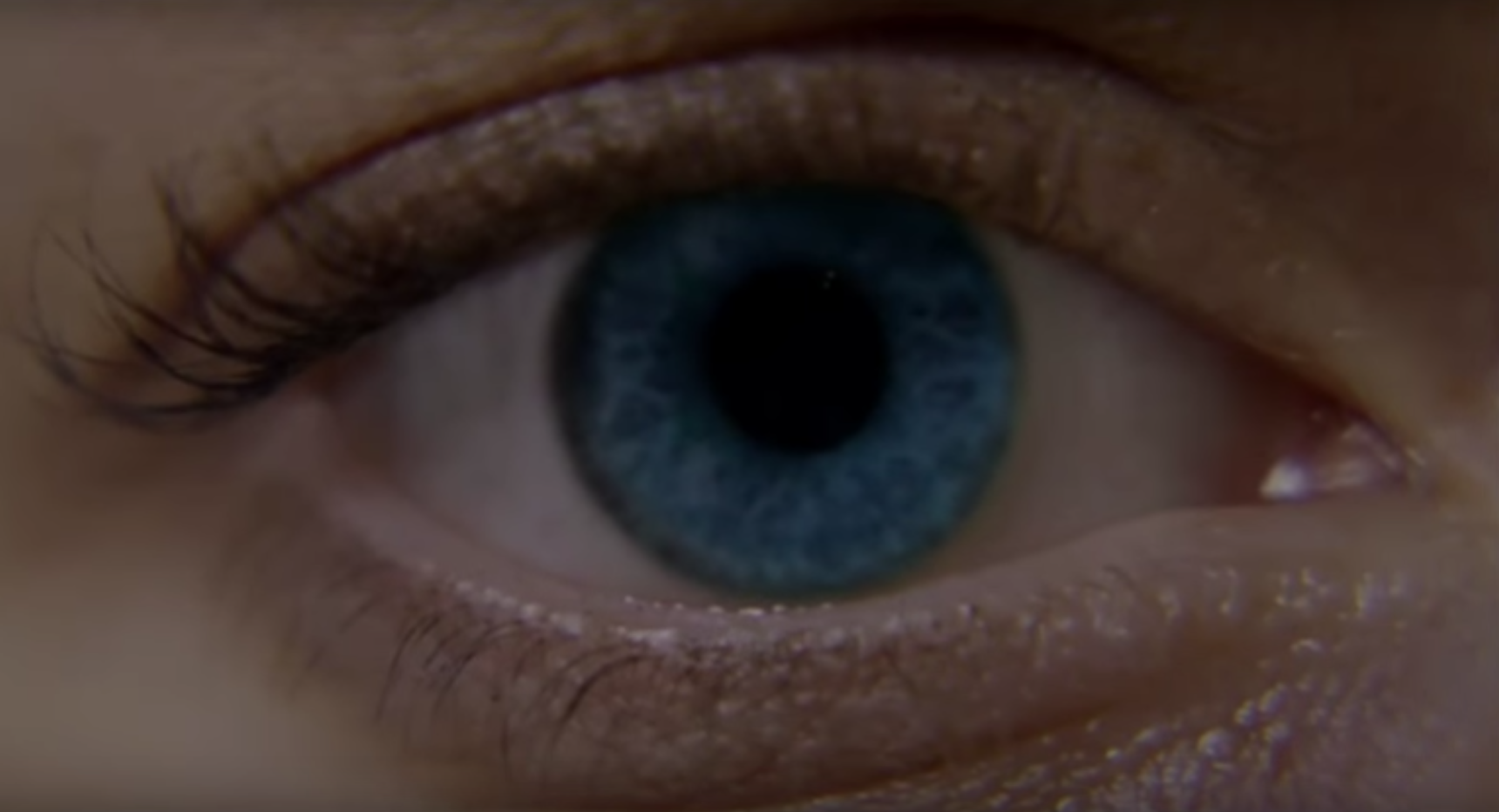
  • Extreme Close-Up – the very beginning of the opening consists of an eye and changes color once it blinks. This immediately lets the audience know that something’s amiss and presents symbolism and foreshadowing that will be elaborated upon later on in the movie.
  • Tracking Shots – the opening mainly consists of tracking shots of the protagonist traversing the house, which simultaneously progresses the plot as the viewers follow her conversation on the phone with her sister, while allowing the viewers to see the house and accustom themselves with the setting.
  • Insert Shots – these shots, which focus on a specific detail or aspect that can be considered important, usually outside of the main action, were used in the opening (Types of Shots). Multiple insert shots are utilized, first having the camera rest on figurines on a shelf, next, the inside of the room the protagonist was sleeping in, then the end of the hallway the protagonist traversed, and lastly resting on the kettle of water that was being boiled. These shots, which are separate from the protagonist’s current placing, hold some importance unknown to the audience, as the camera spends more time on them than necessary. It can later be assumed that the middle two shots were from the perspective of the stalker, as it is revealed that someone else is in the house.
  • Dolly Shot – This is a shot where the camera is put on a dolly and records as it moves (Media College). In one shot, the camera moves closer to the protagonist suddenly before she turns around, suggesting a presence behind her. This drastically increases the tension, as the scenes before this were rather tame and uneventful.

Editing

  • Long Takes – the majority of the takes last about 30 seconds. These slow cuts draw out the scenes and immerse the audience further into the setting and plot. Additionally, some unconventional shots seem to last a bit too long, such as the shot of the end of the darkened hallway after the protagonist’s conversation with her sister. Shots such as these that don’t end in the expected time begin to become creepy and unnerve the audience.

Sound

  • Silence/Diegetic Sound – in the beginning of the opening, there is no sound. The scene is completely silent except for the sounds that the protagonist makes or comes from the setting of the film. This serves not to unnerve the audience, but to immerse the audience into the setting of the film and calm them, as the events at the beginning of the opening are peaceful, settling them into a place of false security.
  • Ambient Sound – During the scenes that occur during the night, there are cricket sounds occurring in the background, subliminally reinforcing the implication that it is nighttime in the film. As it is not explicitly stated, these sounds help the audience come to this conclusion.
  • Non-Diegetic Sound – the only music that occurs in the opening comes in the beginning when the opening begins and near the end, when the protagonist is on the call with her daughter. The beginning music serves to remind the audience that they are being placed in a horror film as the music is unnerving and creepy, but light. The music near the end gives the impression of impending doom, ratcheting up the tension immensely as the previous events had only hinted towards strange occurrences.
  • Dialogue – the opening not only uses dialogue for exposition for the protagonist’s reasoning for being in the house, but also serves to be the best way to send a chill up the viewers’ spines. When the protagonist’s daughter asks, “Mommy, who’s that behind you?” the tension of the beginning reaches its peak, as reveals to the audience that there is someone else in the house and the protagonist could possibly be in danger.

This opening was greatly beneficial to analyze, in my opinion. The intriguing approach to unnerving audiences and creating tension in the opening/title sequence will be helpful to consider when creating the title sequence for my own project.

Sources:

*Be careful! – this opening contains multiple swear words

We’ve Decided! – A Sound Decision

The last few posts have consisted of a lot of distinction and comparison between the horror and thriller genres. As my group and I were unaware that the differences in these two genres were pretty large, extensive research to understand where the two genres diverged was essential before we moved forward and delved into more specific research.

Finally, our group has decided to go in the direction of a thriller over a horror and stick closer to the conventions of a thriller film. This will most likely mean that we are heading towards an opening that focuses on unnerving the audience and setting it on edge rather than outright scaring them and starting big, perhaps with a character’s death. This will most likely be an easier task to accomplish, however, it will also mean that we must be even more meticulous.

In order to properly set the audience on the ‘edge of its seats’, we’re going to need to set up the right atmosphere and mood. This will require extensive attention to the different parts of the opening: setting, lighting, costuming, cinematography – all of these will need to be deliberate to have their intended effect on the audience. Nonetheless, one of the largest components that we’ll need to be sure has a lot of attention is the sound, which is used in film to heighten a mood, provide us with information about the location of a scene, advance the plot, and tell us about the characters in the story (Cinematheque). This is especially important in the opening of a thriller, since immersing the viewer is vital to unnerve and frighten them. Introducing sounds to sell the setting, whether it be the middle of the woods or the middle of the ocean, will help to draw the audience into the film. It’s impossible to frighten viewers that aren’t absorbed into the movie.

In film, both diegetic sounds – sounds that occur within the world of the film, such as dialogue, doors slamming, and footsteps – and non-diegetic sounds – sounds that occur outside of the world of the film, such as a musical score or sound effects – all add mood and atmosphere to the clip, working to add another layer of meaning to the images on the screen. Pitch, tempo and volume are all very important aspects to consider when creating the sound for a scene as well, as a slight shift in any of the three can change the feel of the scene entirely. However, “one of the most interesting uses of sound in a movie is the absence of it” (Cinematheque). Silence, an unnatural state of sound in the outside world, is an effective device in thriller films, ratcheting up the intensity of a scene the longer it persists. Removing most or all auditory stimuli allows viewers’ minds to still and take in any other stimuli even more fully as well as fill in the ‘empty space’ with their own thoughts and fears.

Looking into different thriller title sequences will help me to see these conventions in action as well as give me and my group more ideas as to how to utilize these effectively in our own title sequence.

Sources:

Title Sequences: An Overall Glance

Title sequences, the method by which films or television programs present their title, key production and cast members, utilizing conceptual visuals and sound. Now, how the title sequences go about presenting this is about as vast as the types of movies that one can produce. These sequences can vary largely in their approach, such as utilizing:

  • A single long take that introduces characters, setting and plot
  • An introduction of the protagonist
  • A foreshadowing of the action to come
  • A condensed representation of the story or plot
  • A prologue or the beginning of an epilogue
  • An abstract representation of the story or its themes or
  • Multiple combinations of the above or something else entirely (Frame.io).

With so many possibilities as to the direction one can take for these title sequences, how exactly does one narrow down the options and decide the direction to take with them?

Well, there are many things to consider and understand about title sequences before producing one. First are the goals that should be achieved by a title sequence.

Title sequences are essentially art forms in themselves and because they are the first part of the film that the audience is exposed to, they need to have the proper intended affect to draw them in and set the mood; this is the primary job of a title sequence. All well planned films have certain ways that they want their audiences to feel throughout the movie, especially at the beginning. The main task of the title sequence is to help get the viewers in the right mood for the ensuing scenes, functioning almost like “an airlock between everyday life and the state you go into when you come back to watch a show” (WIRED).

Title sequences must also be deliberate in their approach. They certainly should not be too long as to lose the audience’s interest and should not be too short as to not properly set the intended mood and atmosphere. The cinematography and framing of each scene needs to be intentional as the time to develop meaning is short but still needs to be as poignant as possible.

from Se7en

Another feature of title sequences that needs to be an intentional decision is the typography, or the style, arrangement and appearances of letters, numbers and symbols. The fonts that one uses, and the placing of titling is just as important as the cinematography as it can convey a lot about the story, brand and overall feeling of the intro. This can be easily seen in the case of the title sequence for “Se7en” (1995). The unconventional font and oddly spaced, glitching titles work with the many different close-up shots and discomforting mise-en-scene to impart an uncomfortable mood onto the opening. This is a perfect example of the title sequence setting up the mood and leading the audience into the main film with them already having a predisposed notion about what is to come. Imagine if this title sequence instead utilized light green, 12-point Times New Roman font to display the titles; the feel of the intro would be completely different. Despite this being an extreme example, there are many title sequences that do not consider the typography of their opening although it can have a large impact on the overall feeling of the sequence. A more detailed analysis of this opening and other openings like this will come in a later post.

Se7en Opening Title Sequence

The other thing that needs to be considered in a title sequence is the secondary goal that the film-makers hope for the sequence to achieve; one of these goals may be establishing the point of view of the film. If the movie is centered around a character, the film-makers may hope to establish who the movie will be following and give the audience a general idea of who that character is as well as their situation. Another possibility of a secondary goal is setting the theme. Films are usually about something, whether it be hinted at or overtly stated. Sometime films may decide that they want to begin revealing to the audience what their film is about early in the film, whether it be “things may not be as they seem,” or that “life is like a box of chocolates. You never know what you’re gonna get.” Lastly, the title sequence may serve the function of immersing the audience into a new world. Whether it be a fantasy world, a blissful Iceland landscape or a dark, rural neighborhood with odd inhabitants, the intro is the gateway in to the world that the film will take place in and, if done right, will hopefully absorb the viewers from the start and keep them hooked for the entire movie.

Title sequences are a largely important part of a film that need to be handled with great precision and intention with the goals of what one wants to achieve planned out. To get an idea of how the opening sequences in my genre set the mood and create meaning, I will analyze the conventions they utilize in depth in a later post. This analysis will certainly help to improve the quality of our title sequence.

Sources:

Although this video mainly talks about TV title sequences, it still relays some beneficial information that also applies to film openings

A More In-Depth Look into Thriller vs. Suspense

Despite having similar characteristics and overlapping in certain areas, especially in modern films, thriller and horror are separate genres that slightly diverge in their genre conventions as well as in their dramatic context in more nuanced ways.

The largest way that the horror and thriller genre overlap is because of the “fight versus flight” context that encompasses the film. Most often, in the first half of the movie, the characters are confronted by an issue of some kind and flee or attempt to flee, then are often forced to engage with that issue in the second half or last third of the film. However, how the characters respond to and deal with these issues is usually where the two genres begin to diverge.

from Happy Death Day

Most often, in the horror genre, the protagonist and main characters make active decisions that take them directly to the antagonist’s “literal or metaphorical lair” (Bang2Write). An example of this can be seen in the 2017 horror movie, “Happy Death Day,” where the protagonist – Theresa “Tree” Gelbman – is being hunted by a mysterious killer and waking up in her bed to repeat the day she was murdered in. Realizing she is in a time loop, she begins to take advantage the loop to identify her killer, ultimately leading to a direct confrontation. This active searching is common of the horror genre.

from Get Out

In the thriller genre, however, the protagonist is more often drawn against their will into the antagonist’s evil plan. This means that the antagonist usually makes the active decisions against the main character and drives the action, leaving the protagonist to be unsuspectingly drawn to them. This can be seen in the thriller, “Get Out,” where the protagonist, Chris Washington, is beckoned to his girlfriend’s house, which turns out to be a family who harvests black people’s bodies and replaces their consciousness with that of a white buyer’s psyche. This allows the person who bought the body to have the abilities and talents of the black people that they lured. In the film, Chris is primarily drawn into the antagonist’s “lair” early in the movie when invited to the girlfriend’s house and is then led through the mystery of what is truly occurring through the family’s odd actions. The slightly more passive tendency of the protagonist is often a characteristic of the thriller genre.

Another large difference in the genres rests in the means of reaching the climax of the film:

  • Horror leads viewers to the climax of the film by creating a visceral sense of fear and dread that lasts throughout. By presenting terrible things happening to people onscreen, it causes the audience worry about what will happen next. To do this, films will likely input moments of quiet, dread and reflection. Horror movies very often lead viewers through the film with scares and the fight for survival
  • Thriller will more likely utilize tension and escalation to lead to the climax of the film than dread. These movies will usually continue to increase the tension of each scene until a large showdown results after the protagonist overcomes multiple expositional barriers that were in their way. Thrillers are usually encompassed around mystery and are about “the chase.”

Of course, these genres can overlap. Horror films can certainly be “thrilling” and thriller films “horrifying.” These conventions do not apply to every movie and there can often be horror films with thriller elements and vice versa. However, many well done horror or thriller films stick closer to either genre, as sitting too far in the middle of the conventions of both genres can cause the plot and scares to fall flat. As I will only be making a title sequence detailing the first two minutes of the film, I will not have to worry about following through with the tension and scares, however, keeping the general direction and format of the “rest of the film” in mind will certainly benefit my opening sequence.

It will be important to narrow down the genre we are going for based on these conventions as it will influence the tone and direction of the title sequence.

Sources:

‘Horror vs. Thriller’ Informational Video